2026-06-30
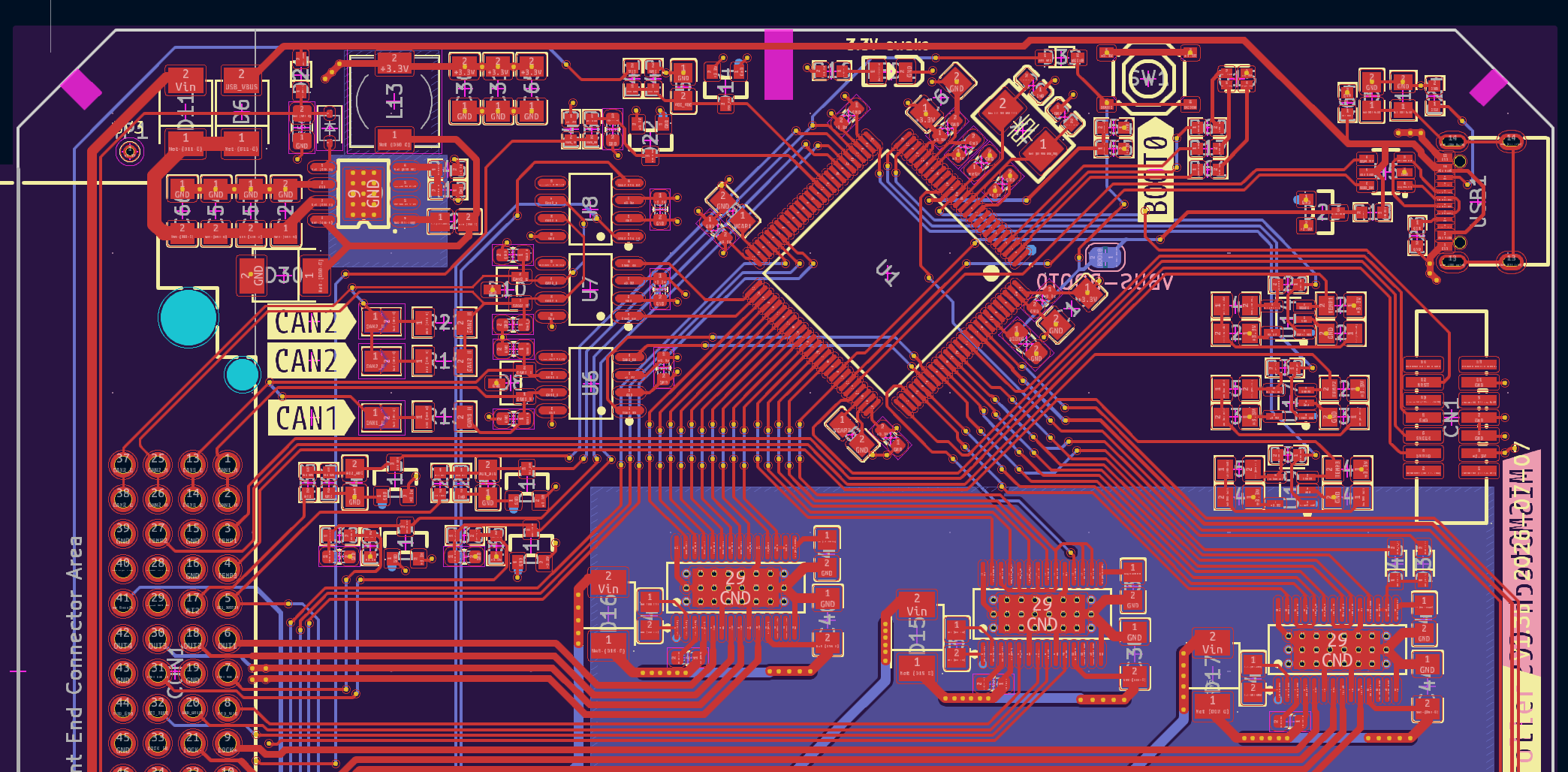
Designing the boards, not just the firmware
Firmware gets most of the attention on this site, but it needs to run on something. Nearly every product I work on has a printed circuit board I designed myself, from the first schematic symbol to the Gerbers that go to the manufacturar.
From schematic to a board in hand
The flow is the usual one, just done end to end:
- Schematic — choosing the parts, the power architecture and the protections, and capturing it all in a way that is easy to come back to later.
- Layout — placement and routing, controlled impedance where it matters, attention to grounding, and 3D checks against the enclosure so everything actually fits.
- Manufacturing — is mostly done external these days. Robots are much more accurate and 1000 times faster than humans when it comes to placing millimeter size components with micrometer precision.
Most of this happens in KiCad, which has become my main tool.
The bench: soldering, rework and testing
A board is not done when the layout passes DRC — it is done when a real one powers up and behaves. I assemble and bring up the prototypes myself, by hand:
- Rework — the honest part of prototyping. Lifting a part, cutting a trace, tacking on a bodge wire to prove a fix before it goes into the next revision. A first spin almost never lands perfectly, and being able to rework it quickly is what keeps the iterations short.
- Testing — powering up carefully, checking rails and signals, then exercising the board with its firmware to confirm it does what the schematic promised. Whatever the bench turns up feeds straight back into the next revision.
Designing, building and debugging the same board closes the loop tightly: a problem found with a soldering iron in hand usually becomes a better schematic, not just a patch.
Every board is its own puzzle
The interesting part is that no two of these boards want the same thing:
- High voltage — the CCS charge controller sits on a pack of up to 1000 V, so the layout is really an exercise in isolation: creepage and clearance, galvanically separated domains, and keeping the low-voltage logic genuinely safe from the HV side.
- Very low power — the POND boards run on electricity harvested from microbes in the water, which is a tiny budget. There the whole design is bent towards efficiency, because there simply is not much energy to spend.
- Rugged environments — automotive and marine hardware has to shrug off vibration, temperature swings and damp. That shows up in connector choice, in strain relief, in EMC, and in designing for the IP67, DIN-rail or ECU enclosures the boards live in.
Where it fits
If you have an idea that needs its own board — a gateway, a controller, a sensor node — this is the part of the work I most enjoy: turning a rough requirement into hardware that is manufacturable, testable and built for where it has to run.