2026-06-20
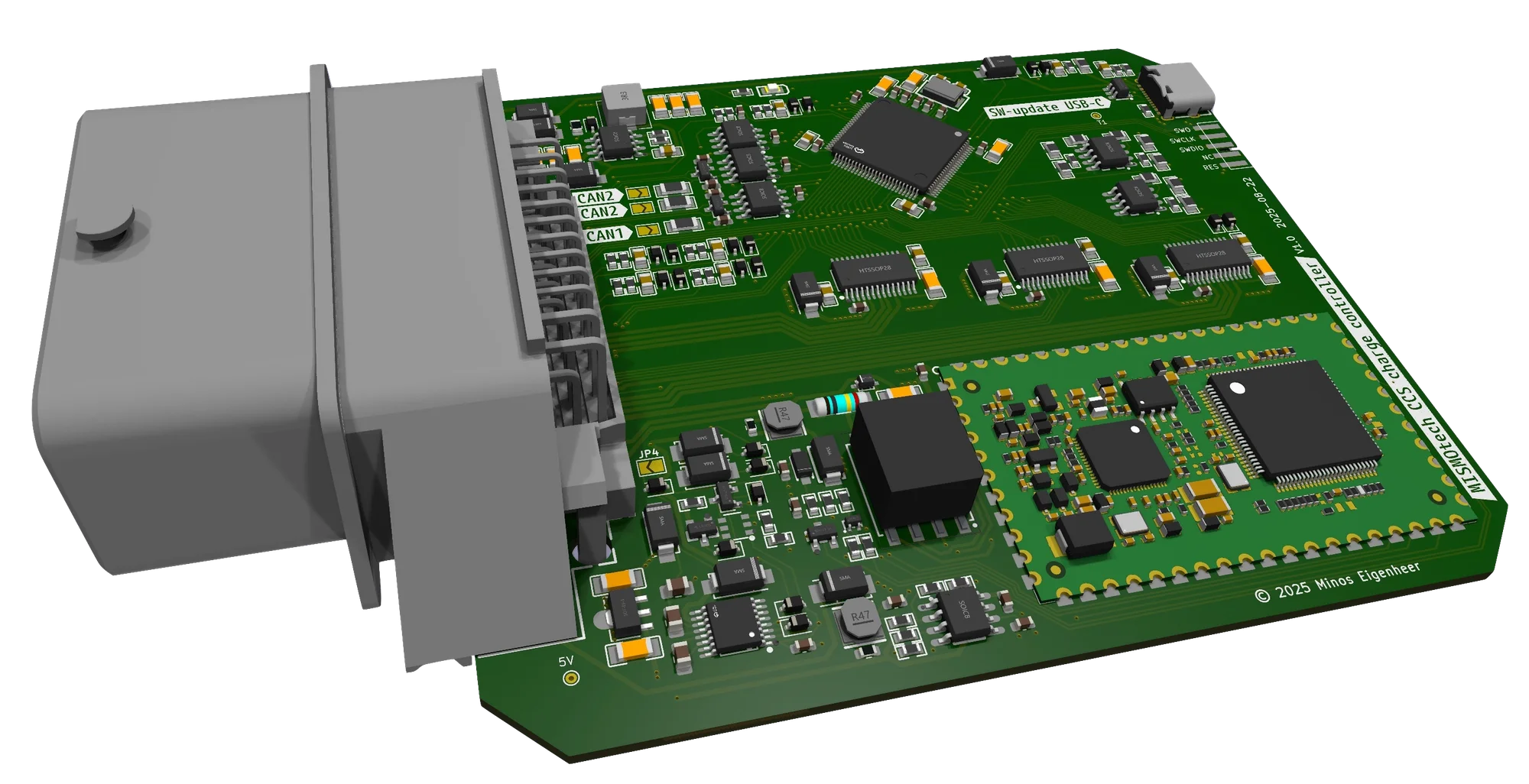
A CCS charge controller for EV conversions
Series-production EVs charge on a public DC fast charger because a controller inside the car speaks the charging protocols and negotiates with the charger. Most EV conversions never get that far: they can charge slowly over AC, but the CCS fast-charge posts stay out of reach.
This charge controller closes that gap. It sits between the conversion's battery and the charge inlet and handles the whole conversation — from plugging in, through the charger and vehicle agreeing on limits, to opening the contactors when the session ends.
What it does
- AC and DC charging — low-level CP signalling (PWM) for AC Type 2, and high-level powerline communication (PLC) over CP for CCS DC fast charging.
- Standards — built against ISO 15118-2, ISO 15118-20 and DIN 70121, and covers charging modes 1 through 4.
- Battery integration — talks CAN to an EMUS BMS, so charge current and cut-off follow the pack's real state.
- Everything around the port — drives the HV contactors, the charge-port lock actuator, the stop button and RGB status LEDs.
How it is built
The firmware runs on an STM32 microcontroller, written in embedded C. The high-level CCS side leans on the PLC stack for the ISO 15118 handshake, while CAN ties the controller to the BMS and to diagnostics tooling (a PCAN-USB adapter is handy for logging a session).
Where it fits
It is meant for people building a proper EV conversion who want more than an overnight AC charge — a battery pack in the 250–1000 V range, up to 500 A, and a CCS2 inlet. The controller supplies the intelligence; you supply the contactors, sensor and inlet to match your system voltage.
Curious about the hardware? See the CCS Charge Controller.