2026-06-05
Light, water and radio: firmware work on Nova Innova's POND
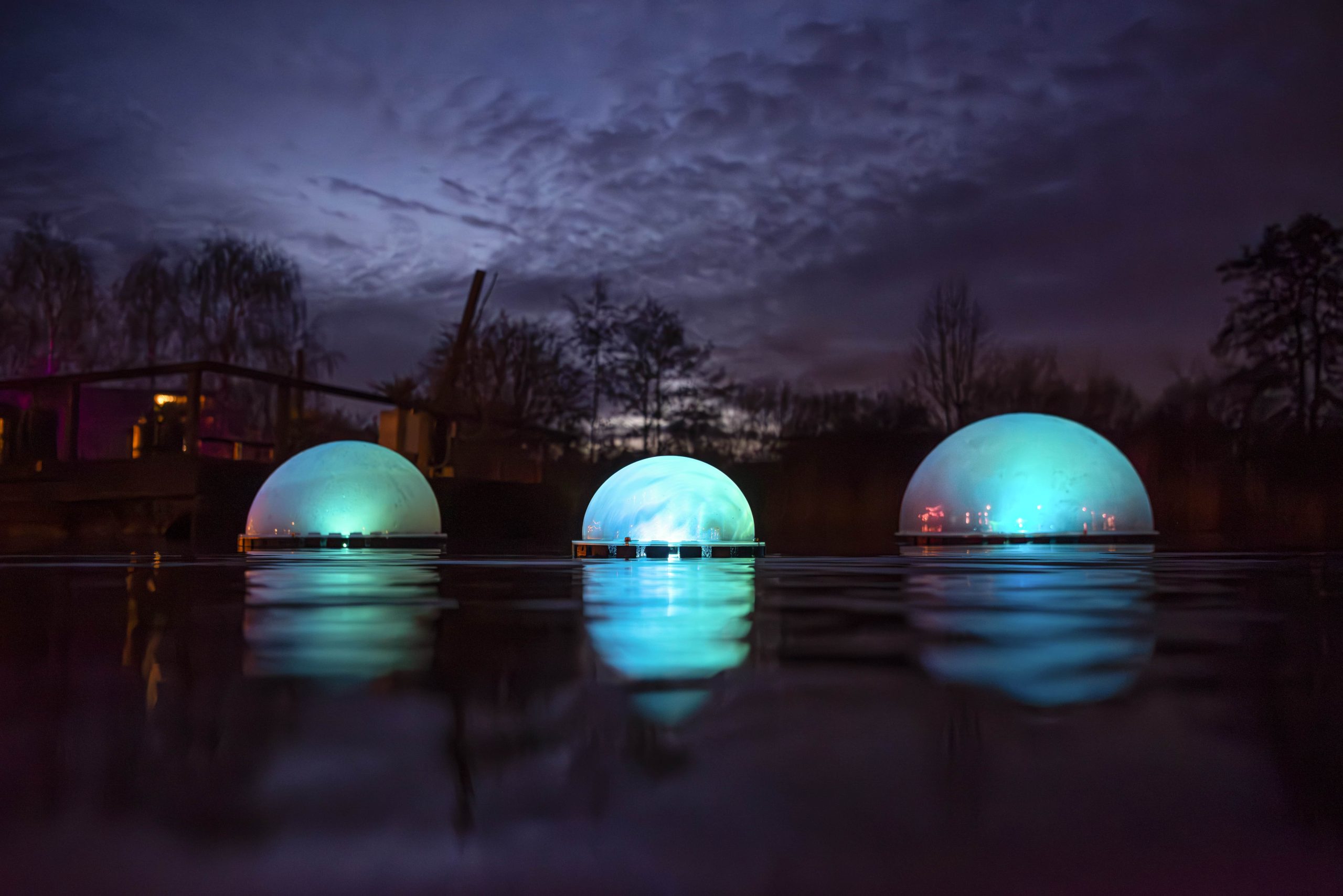
POND — short for Power of Nature-Based Design — is an interactive installation by Nova Innova: Bacteria in the water break down organic matter and release electrons, and POND captures those electrons to generate electricity — no battery, no plug, and no harm to the ecosystem. That trickle of power runs the water-quality sensors and, after sunset, lights up floating domes whose colour reflects how the water is doing. The length of the light animation depends on how much energy the microbes harvested. The idea is simple: give the water a voice.
I did not write the original firmware, and I want to be clear about that. Over the past two years I have worked on the STM32 firmware that runs the POND nodes, adding features and improvements on top of an existing base.
What I added
- Lighting animations — smoother, richer light behaviour on the nodes, so the installation reads as one connected field rather than separate lamps.
- Water-quality sensing — reading Atlas Scientific sensors (pH, EC, dissolved oxygen, temperature) over I²C, so POND measures the water it sits in.
- Radio communication — nRF-based links between the harvester and a ParkRouter which sends data to the cloud.
- Logging and dashboards — pushing measurements into InfluxDB and visualising them in Grafana, so trends over hours and days are actually readable.
How it is built
The nodes run on STM32 microcontrollers, firmware in embedded C. Sensors hang off an I²C bus; the nRF radio handles communication to a router which feeds readings into an InfluxDB time-series database with Grafana on top for the dashboards.
Why I wanted to work on it
Mostly it is the team and the mission. Nova Innova describes itself as "an ecosystem in every sense of the word" — scientists, engineers, designers and electronics people in one small studio, founded by bio-tech designer Ermi van Oers. Their aim is to "reconnect humans with the brilliance of nature" and to build a future where "ecosystems have a voice", and they measure themselves by holistic rather than financial growth. That is a rare thing to be able to work towards.
The challenge is the other half of it. Harvesting electricity from microbes is still a largely unknown technology, and the amount of power involved is tiny. Every part of the firmware has to respect that: the devices need to be extremely efficient to do anything useful with the little energy the water gives them.
Companion piece: the POND sensor calibration tool that keeps those water-quality sensors honest.